-1.jpg?width=339&height=588&name=credit-cards-hero%20(1)-1.jpg)
Credit cards for bad credit: what you need to know before applying
May 27, 2025

The information provided on this website does not, and is not intended to, act as legal, financial or credit advice. See Lexington Law’s editorial disclosure for more information.
APR stands for annual percentage rate, and it is often overlooked when people sign up for a line of credit. According to the Consumer Financial Protection Bureau, the average American household pays about $1,000 in credit card interest each year. By lowering your interest rates by even a few percentage points, you can save thousands of dollars in credit card fees as well as on a home, auto, or personal loan.
Here, you’ll learn about the meaning of APR, how it works, and what you can do to get better interest rates by improving your credit.
One common way people accrue interest is by only making the minimum payment every month. Let’s say you have a credit card balance of $1,000, an APR of 18.99 percent and a minimum payment of $25. If you only pay the $25 every month, it will take you 62 months to pay off the entire amount. You’ll also pay around $540 in interest.
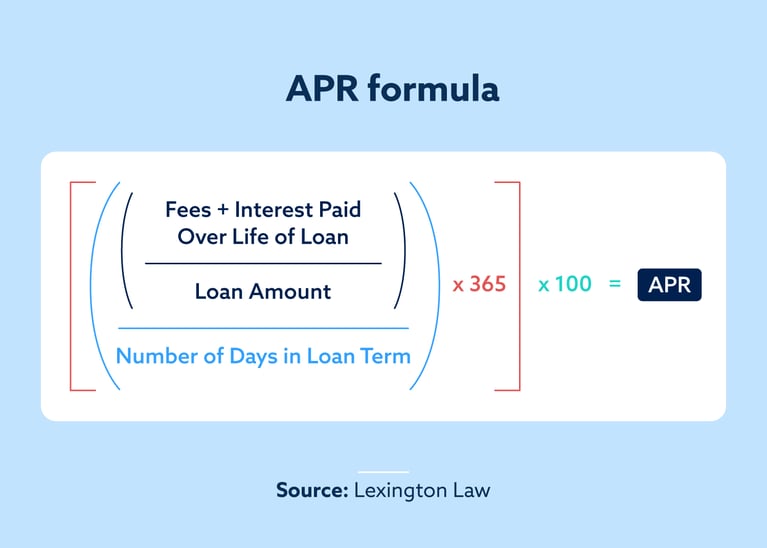
While this interest rate is expressed annually, you’ll get charged monthly. The monthly APR formula is just your APR divided by 12. So, if you used the above APR formula and have an APR on a credit card of 18.99 percent, the monthly rate is 1.5825 percent.
Whenever you sign up for a credit card or loan, it’s helpful to calculate the APR to have an idea of how much you’ll pay each month.
APR can vary depending on the line of credit you’re using and what you’re buying.
If you forget your credit card’s APR after you sign up, it should be listed in the terms and conditions of your specific card agreement. You can also find the APR on your monthly credit card statements or your card issuer’s website.
If you still can’t find your card’s APR or you have other questions, you can reach out to your card issuer directly.
Annual percentage yield (APY) is typically used by investment companies to describe how much interest you’ll earn on money that you’ve invested, so this is much different than APR on a line of credit or a loan. APR is a term most often used by lenders, and it doesn’t take compound interest into account. APY is sometimes also called the Effective Annual Return (EAR).
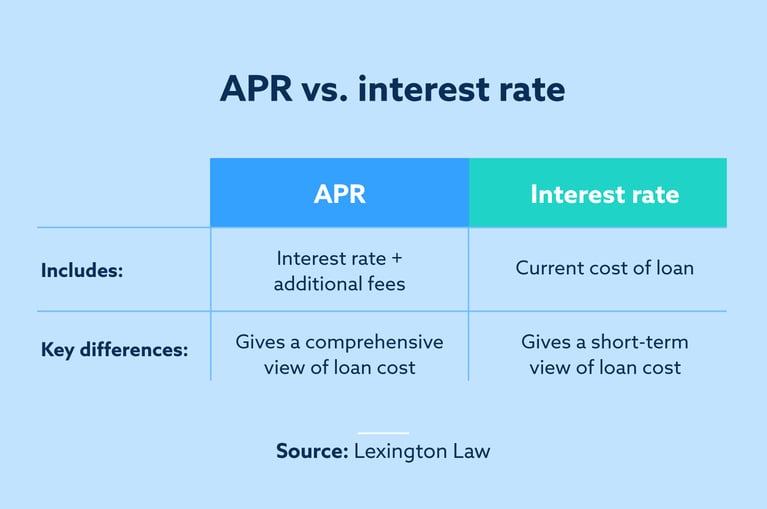
The terms interest rate and APR are often used interchangeably, but they’re actually two different rates.
Your interest rate is the amount charged on the balance of your debt. If you look at a credit card with a balance of $500, a monthly interest rate of 1.65 percent would only apply to the $500 balance.
In comparison, APR can be much more comprehensive and include other borrowing costs, such as fees, insurance, closing costs, and more, especially with things like loans. Since the APR can include additional costs, it’s often a higher rate than the interest rate on its own.
When there are no extra fees, the APR and the interest rate can be the same. This is often the case with credit cards.
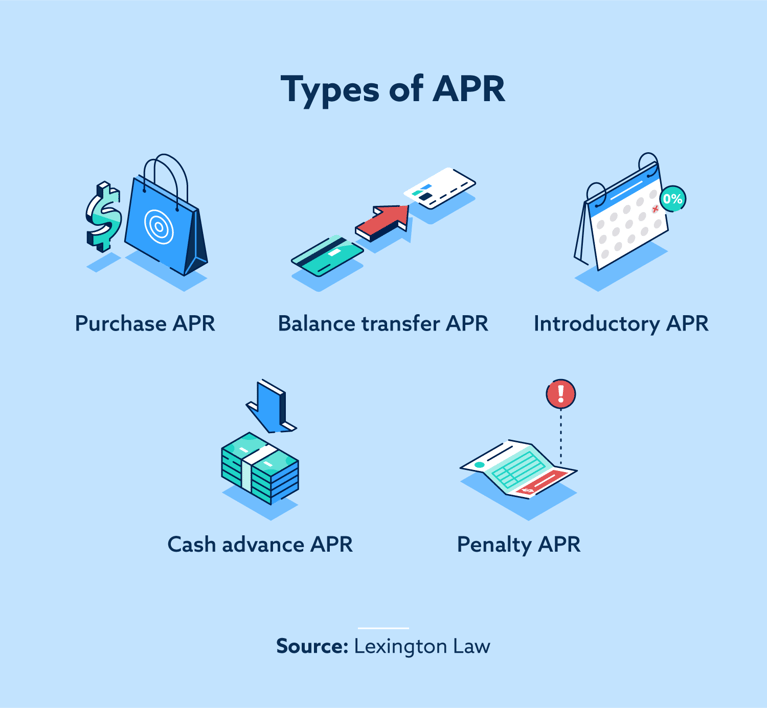
It’s beneficial to understand the different types of APR in addition to the actual percentage rate. Understanding how the types differ can help you avoid surprises on your statement. The APR on a car or home loan may be different from the APR on your credit card, and there are different factors that may cause each to change.
Your loan or credit typically comes with one of two types of APR: variable or fixed. As the name implies, a fixed APR remains constant, but the variable APR changes. Fixed APR typically applies to mortgages and personal loans. For example, you might lock in a mortgage rate of 3.99 percent for 15 years.
A variable APR fluctuates with a specific index interest rate, usually the prime rate. If the prime rate increases one month, so will your APR. However, if the prime rate decreases, you may benefit from a lower APR that month. Note that a variable APR can make it much harder to budget as it’s constantly changing.
Credit cards often have a variable APR. So let’s say you sign up for a new credit card and its APR is initially 16.99 percent. Just a few months later, you might see that the APR is now 24.23 percent.
Keep in mind that a fixed APR can still change, often triggered by a missed payment or a market crash. However, your lender has to notify you before making the change.
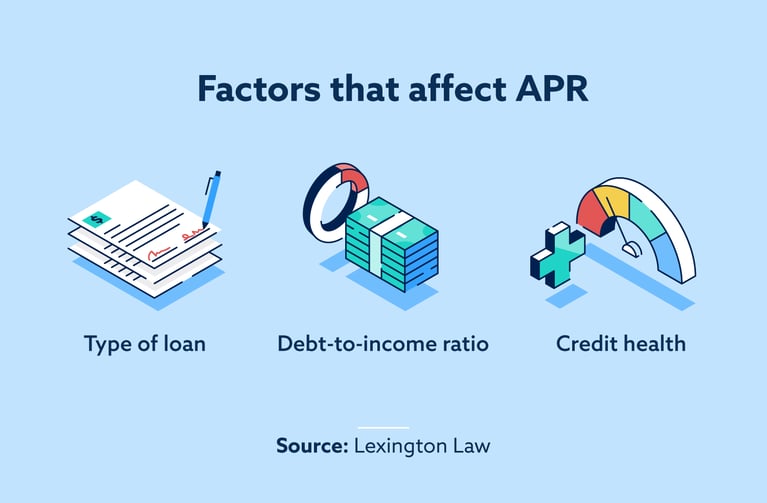
A “good” APR depends on the person as well as the circumstances. As you now know, your APR can change based on your credit score and other factors. By having a healthy credit score, you’re often able to get much better rates, and this is something that’s more within your control. Two of the factors that are outside of your control are market conditions and the economy, which can also affect how flexible financial institutions are with APR.
Improving your credit can take some time, but it’s worth the effort. It could mean better percentage points on APR, which in turn could save you thousands of dollars.
Without realizing it, some people have errors on their credit report that result in a lower score and higher interest rates. If you find errors on your credit report, it’s beneficial to have credit consultants on your side. Lexington Law has a team that’s helped thousands of people challenge errors on their credit reports, and we could help you too. We also have additional services like credit monitoring and financial education tools to help you maintain good credit.
To learn more about how Lexington Law could assist you with your credit repair needs, sign up today.