
How to remove inquiries from a credit report
May 06, 2025

The information provided on this website does not, and is not intended to, act as legal, financial or credit advice. See Lexington Law’s editorial disclosure for more information.
A repossession is a negative item listed on your credit report that can hurt your credit score. Repossessions note the seizure of any assets due to late or delinquent payments. If a repossession is listed on your credit report, there is still a way to rebuild your credit and potentially get the listing removed from your credit report.
A repossession is when property is seized due to not paying a debt. If you’ve taken out a line of credit on something like furniture, a car, a television or anything similar, it’s at risk of repossession if you don’t make your payments. Depending on the lender, the time at which an item is repossessed after a late payment can vary after the payment is missed.
The best way to avoid repossession is to make your payments each month in full and on time. But, if you believe you’re going to miss a payment or be late, it’s best to be proactive by contacting the lender to see if you can receive a grace period or negotiate a deal to prevent repossession and damage to your credit.
There are a couple of things you can do to try to get a repossession removed:
If you do this, the credit bureaus must investigate and will ask the creditor to verify the information regarding your repossession. If the lender doesn’t prove that your debt is accurate, fair and substantiated, the credit bureaus may remove the repossession from your credit reports.
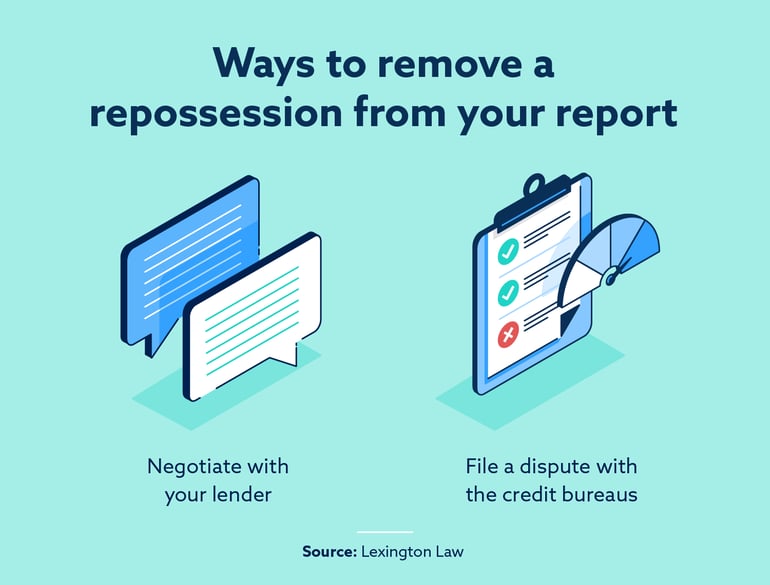
Your window to negotiate with your lender may be short or already closed if they repossessed your asset. In this case, filing a dispute is the option to consider.
You’ll need to initiate a credit dispute and prove to the credit bureaus that the repossession is fraudulent, outdated or otherwise inaccurate. Here are a few steps you can take:
A repossession can stay on your credit report for up to seven years. It may be harder to qualify for loans during this time because repossessions have a severely negative impact on your credit, and they can show lenders that you are unable to make payments on the property you purchase.
When you have a repossession on your credit report, you can expect your credit to be negatively affected, but exactly how much depends on your credit situation. Here are some ways that repossessions can affect your credit:
Future lenders will use this information to determine if you are creditworthy.
Repossessions occur when a borrower falls behind on payments for an asset purchased with credit. If a lender thinks the owner is not going to catch up on payments, they may decide to repossess the property.
Repossessions are most common with car loans, but they can apply to any loan that involves collateral, for example, furniture from a furniture store.
A voluntary repossession, sometimes referred to as a vehicle surrender in the case of a car, is when a consumer voluntarily gives the asset back to the lender. There is a common misconception that a voluntary repossession is better for your credit than a forced repossession. In financial and credit terms, they’re very similar.
Whether you voluntarily ask your lender to come and pick up their property or it's forcibly repossessed, the message is the same: you are unable or refuse to pay your loan and the lender is taking back their property.
One benefit of voluntarily surrendering your property is that it is less emotionally draining and embarrassing than having a forcible repossession, which can happen at any time and any place. Voluntarily repossessing your property gives you a bit more control and usually ends up costing less.
Yes, a lender can come after you for money owed on the car known as a “deficiency balance.” Once a creditor repossesses the collateral, they usually try to resell it to recoup their money. For things that depreciate over time, like cars, the lender won’t recoup the full amount of the loan because the car is worth less than when the consumer first bought it.
When a lender sells items for less than what is owed, they’ll come after the purchaser for the difference.
The short answer is yes, you can still get a loan after a repossession. However, there are relatively few lenders who are willing to take a risk on someone with bad credit or negative marks on their credit report. Those who are willing may require you to pay higher interest rates and fees.
However, there are reputable lenders out there who have approved applications with repossessions on them. For better chances of approval and better interest rates, you can find someone with good credit to cosign the loan for you.
You can also work to improve your credit and payment history to make yourself a better candidate.
It’s definitely possible to acquire a car loan after a repossession, but this often comes with its downsides as well. The repossession will stay on your credit report for up to seven years, which will lower your credit score. There are high-risk lenders and car dealerships out there, but they’ll typically require a larger down payment or will charge much higher interest rates, making the car cost far more than it would if you had healthier credit.
It’s definitely possible to acquire a car loan after a repossession, but this often comes with its downsides as well. The repossession will stay on your credit report for up to seven years, which will lower your credit score. There are high-risk lenders and car dealerships out there, but they’ll typically require a larger down payment or will charge much higher interest rates, making the car cost far more than it would if you had healthier credit.
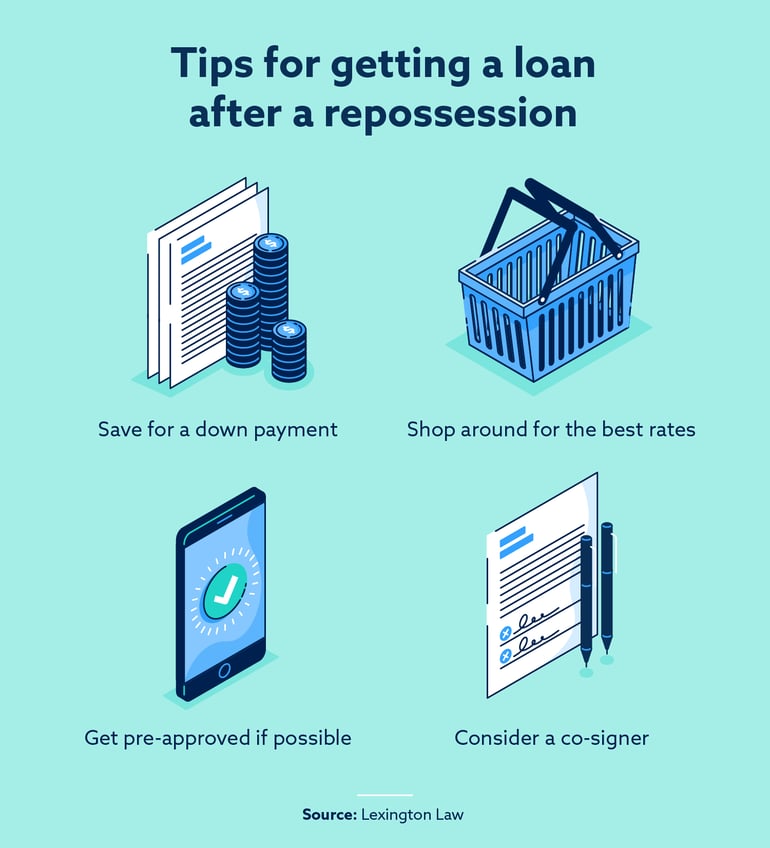
Many people go through financial troubles at some point. If you're struggling to stay on top of your payments, you should communicate this with your lender to see if you can change your payment plan.
For car loans, if you know your financial hardships are going to be temporary, you can talk to your lender, Working things out with your creditor may prevent a repossession and allow you to keep the property.
If you do get approved for a loan or a new line of credit after a repossession, making payments on time can help you build your credit back up.
If you dispute the repossession and can’t get it removed, then you need to give it some time. Your credit score will eventually improve as you open new accounts and make on-time payments, you should gradually see your score improve.
If you’re struggling with a low credit score or other negative items on your credit reports, Lexington Law Firm could help you through our suite of credit repair services. For over a decade, our team of consumer advocates has helped clients work to challenge negative information that is unfair, inaccurate and unsubstantiated. Contact us today for a free, personalized credit report consultation.