In 2022, 61 percent of Americans were reported to own stock.
The stock market is a set of financial exchanges in which investors purchase and sell shares of companies and industries. Investors purchase shares to grow their business or raise money. The market typically references two major stock indexes: the S&P 500 and the Dow Jones Industrial Average. These indexes track the ever-changing performance of companies within the stock market.
Because the stock market is constantly in flux, it’s important to stay up to date with the latest trends and facts. We curated this information to provide a stock market summary—everything from the size of the global stock market and the different countries and companies that make it up to who invests in the stock market. Staying in the know with these latest trends can ensure you make better-informed decisions about investing.
In this guide, explore the top stock market statistics and facts to know in 2023.
Global market by the numbers
Nearly all countries participate in a global stock exchange that allows for both local and international companies to be traded. The number of traded companies can vary from a couple hundred to as many as a couple thousand, but it’s usually proportionate to the size of the country. To learn more about the global stock market, check out these facts below:
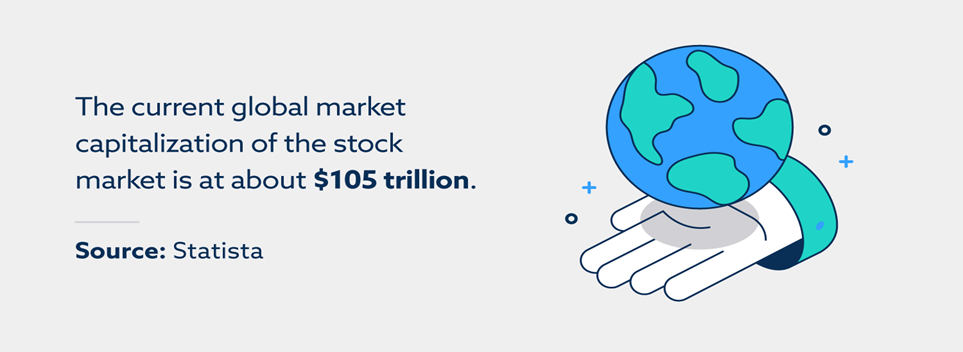
The global market capitalization is around $105 trillion. (Statista)
In 2022, the global equity market capitalization declined about 20 percent compared to the last quarter of 2021. (World Exchanges 2022 Market Report)
Compared to 2021, there were fewer IPOs and less money was raised through them (-50 and -65 percent, respectively). (World Exchanges 2022 Market Report)
The National Stock Exchange of India increased 134.5 percent compared to 2021, amounting to 32.57 billion contracts, the highest annual figure in the last six years. (World Exchanges 2022 Market Report)
The growth of the global GDP is forecast to climb by 1.6 percent in 2023. (J.P. Morgan)
The top 10 countries by world stock market capitalization as of May 2023 are: (CompaniesMarketCap.com)
United States: $43.7 trillion
China: $6.4 trillion
Japan: $4.4 trillion
India: $3.1 trillion
United Kingdom: $3 trillion
France: $2.9 trillion
Saudi Arabia: $2.6 trillion
Canada: $2.4 trillion
Germany: $2.3 trillion
Switzerland: $2.1 trillion
There are around 60 major stock exchanges in the world. (Forbes)
The top 10 major stock exchanges by market capitalization are: (Statista)
New York Stock Exchange (NYSE): $22.77 trillion
NASDAQ: $16.24 trillion
Shanghai Stock Exchange: $6.74 trillion
Euronext: $6.06 trillion
Japan Exchange Group: $5.38 trillion
Shenzhen Stock Exchange: $4.7 trillion
Hong Kong Stock Exchange: $4.56 trillion
National Stock Exchange of India: $3.34 trillion
LSE Group, U.K.: $3.1 trillion
Saudi Stock Exchange (Tadawul): $2.38 trillion
71 percent of top global investors expect equities to rise in 2023. (Bloomberg)
Of all global stocks, 78.8 percent are controlled by the 10 largest global stock markets. Of that percentage, around 60 percent are managed by the NYSE and NASDAQ. (iExpats)
With a market value of $22.77 trillion, the New York Stock Exchange is the largest stock exchange in the world. The next biggest is NASDAQ with a $16.24 trillion market capitalization—putting the two U.S. exchanges in the top two positions. (iExpats)
As of 2023, the average return of the stock market is around 10 percent. (Seeking Alpha)
U.S. stock market data
The U.S. stock market is the largest and most expensive in the world, with NASDAQ and the New York Stock Exchange topping the list. Here are some important statistics regarding the U.S. stock market:
As of January 2023, the value of stocks listed on U.S. exchanges made up 42 percent of the global total. (Visual Capitalist)
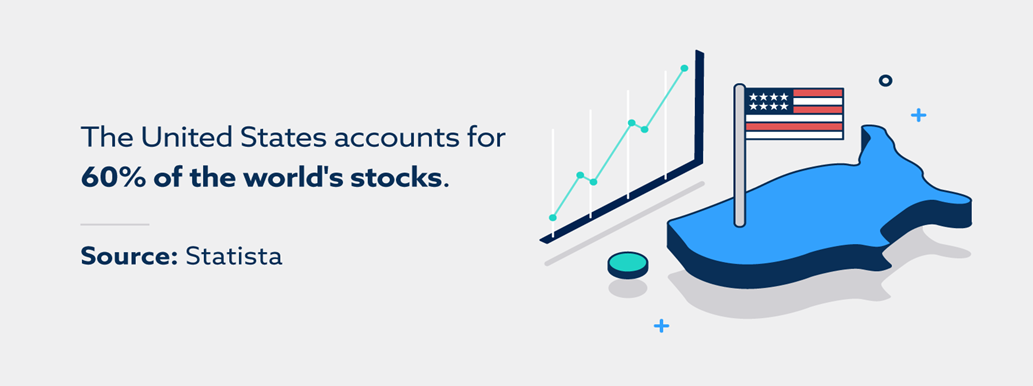
In 2023, stock markets in the United States accounted for nearly 60 percent of the world’s stocks. (Statista)
From March 2021 to March 2022, the market capitalization of U.S. companies in the Global Top 100 increased by 19 percent. (PwC)
The total market capitalization for the U.S. as a percentage of GDP is 153.7 percent as of March 31, 2023. (YCharts)
The top 10 best-performing stock returns in the U.S. as of Q1 2023 are: (Morning Star)
Fastly: 116.8%
Coinbase Global: 90.9%
Nvidia: 90.1%
Meta Platforms: 76.1%
EVgo: 74.3%
Spotify Technology: 69.2%
Rolls-Royce: 69.2%
Tesla: 68.4%
Sea: 66.3%
Roku: 61.7%
The equity markets in the U.S. are the largest in the world—they account for 41 percent of the $107 trillion global equity market cap in 2023. (SIFMA)
As of July 2022, 75.4 percent of equity and debt financing for nonfinancial corporations are provided by U.S. capital markets. (SIFMA)
The top 19 global stock market exchanges have a market capitalization of more than $1 trillion. (Statista)
U.S. GDP growth is forecast to grow by 1 percent in 2023. (J.P. Morgan)
At the end of March 2022, Charles Schwab had $7.86 trillion in client assets. (Charles Schwab Corporation)
Stock market statistics by industry
The stock market today is dominated by tech giants like Apple and Amazon, but it hasn’t always been that way. The stock market is notorious for its cyclical pattern of bubbles followed by crashes like the dot-com bubble and the U.S. housing bubble. Here are the current industries and companies dominating the market:
The U.S. stock market’s largest sector is the technology sector, which saw a 381.9 percent 10-year return vs. S&P 500. (Liberated Stock Trader)
In 2022, technology companies made up 34 percent of the Global Top 100 with a market capitalization of $12 trillion. (PwC)
Since 2018, healthcare companies have increased 84 percent in the Global Top 100. (PwC)
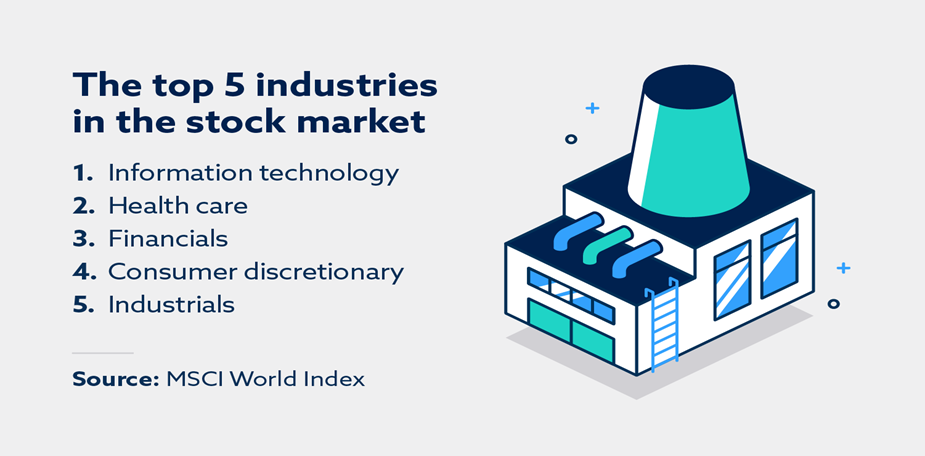
The top ten sectors in the world stock market: (MSCI World Index)
Information technology: 22.3%
Healthcare: 13.6%
Financials: 13.2%
Consumer discretionary: 10.6%
Industrials: 10.5%
Consumer staples: 7.8%
Communication services: 7%
Energy: 5.1%
Materials: 4.3%
Utilities: 3%
Real estate: 2.5%
The top five U.S. industries by revenue are: (IBISWorld)
Hospitals: $1.43 billion
Drug, cosmetic and toiletry wholesalers: $1.36 billion
Pharmaceuticals: $1.29 billion
Health and medical insurance: $1.25 billion
Commercial banking: $1.21 billion
By company
The 10 largest companies in the world by market capitalization as of 2023 are: (CompaniesMarketCap.com)
Apple: $2.8 trillion
Microsoft: $2.5 trillion
Saudi Aramco: $2.1 trillion
Alphabet: $1.6 trillion
Amazon: $1.2 trillion
Nvidia: $992 billion
Berkshire Hathaway: $704.1 billion
Meta Platforms: $672.8 billion
Tesla: $637.6 billion
TSMC: $528.9 billion
The 10 largest companies in the U.S. by market capitalization as of 2023 are: (CompaniesMarketCap.com)
Apple: $2.8 trillion
Microsoft: $2.5 trillion
Alphabet: $1.6 trillion
Amazon: $1.2 trillion
Nvidia: $992 billion
Berkshire Hathaway: $704 billion
Meta Platforms: $672.8 billion
Tesla: $637.6 billion
Visa: $464 billion
UnitedHealth: $447 billion
Apple’s market capitalization is currently $2.79 trillion as of May 2023, making it the world’s most valuable company. (CompaniesMarketCap.com)
As of 2023, the top three publicly traded companies by revenue include Walmart ($622 billion), Amazon ($525 billion) and ExxonMobil ($395 billion). (CompaniesMarketCap.com)
Historical overview
The stock market has roots in history and is one of the integral aspects of the global economy. Dating back hundreds of years, the stock market is one of the oldest forms of investments and is still used daily to help gauge the performance and health of different areas of the economy. Learn more historical facts about the stock market below.
1915 was the best stock market year in the history of the Dow Jones Industrial Average. The index value increased by 81.66 percent to close at 99.15 points compared to 54.58 in the previous year. (Statista)
Since 1875, the U.S. has been in 34 recessions, 13 of which happened after World War II. (USAFacts)
In the last seven decades, the world economy has gone through four major recessions: in 1975, 1982, 1991 and 2009. (World Economic Forum)