
APR vs. interest rate: key differences
June 03, 2025

The information provided on this website does not, and is not intended to, act as legal, financial or credit advice. See Lexington Law’s editorial disclosure for more information.
Key takeaways:
Student loan debt statistics are staggering. As of September 2023, approximately $1.77 trillion in student loan debt affect over 44 million Americans. If you graduated college with substantial student loan debt, you may be wondering about the best way to manage it. Below are eight strategies for paying back student loans.
How to pay off student loans:
After your student loan grace period is over and you begin to explore the best ways to pay off your debt, start by analyzing your budget. The goal is to identify where to trim your budget and determine how much you can afford to dedicate to payments.
While it may not be the most fun thing to think about, cutting areas of your budget is a quick and effective way of paying down debt. Consider reducing or eliminating nonessential expenses such as eating out, going to concerts, or watching cable TV. You could also consider periodic “no-spend” weeks—or even months—where you refrain from purchasing anything nonessential and contribute that money to your student loan debt instead.
Remember that this is a short-term solution for this period of your life when you can focus on paying down debt. You do not need to sacrifice these things forever—just until you get your debt to a more manageable place.
What to do next: Download a budgeting app or money management software that compiles your spending in one place. This will make reviewing your budget quick and easy.
During periods when you are not making student loan payments—most commonly a grace period, deferment, or forbearance—interest will accrue. Once it is time to start making payments, this interest capitalizes, which means your balance will be larger, and you will owe even more interest.
To avoid this capitalization, you have two options: pay off the accrued interest monthly while you are still in school, or pay off the accrued interest all at once before you start making monthly payments. Either way, it will be well worth your while, as capitalized interest can add hundreds or even thousands of dollars to your loan total.
What to do next: If your grace period is ending soon, consider making a lump-sum interest payment. This interest capitalization calculator will estimate how much you owe.
After reviewing your budget and tightening up your spending habits, determine how much you can afford to pay. If you want to pay off your debt quickly and avoid large amounts of accrued interest, consider making larger payments than the minimum requirement.
In some cases, minimum payment requirements are so low that they barely cover interest costs. While they will help you avoid late fees, making only a minimum payment on student loans will cause you to be in debt for a longer period, forcing you to pay more in interest.
As a general rule of thumb, aim to use 10 – 20 percent of your income for debt repayment. This aligns with the 50/30/20 rule that suggests using 50 percent of your income on essentials (needs), 30 percent on nonessentials (wants), and 20 percent on debt repayment and savings.
What to do next: Increase your student loan autopay so that you are paying more than the minimum payment. This way, you will not forget to add the extra amount each month.
Those with federal student loans have a few different repayment plan options to choose from based on the time frame and desired payment size:
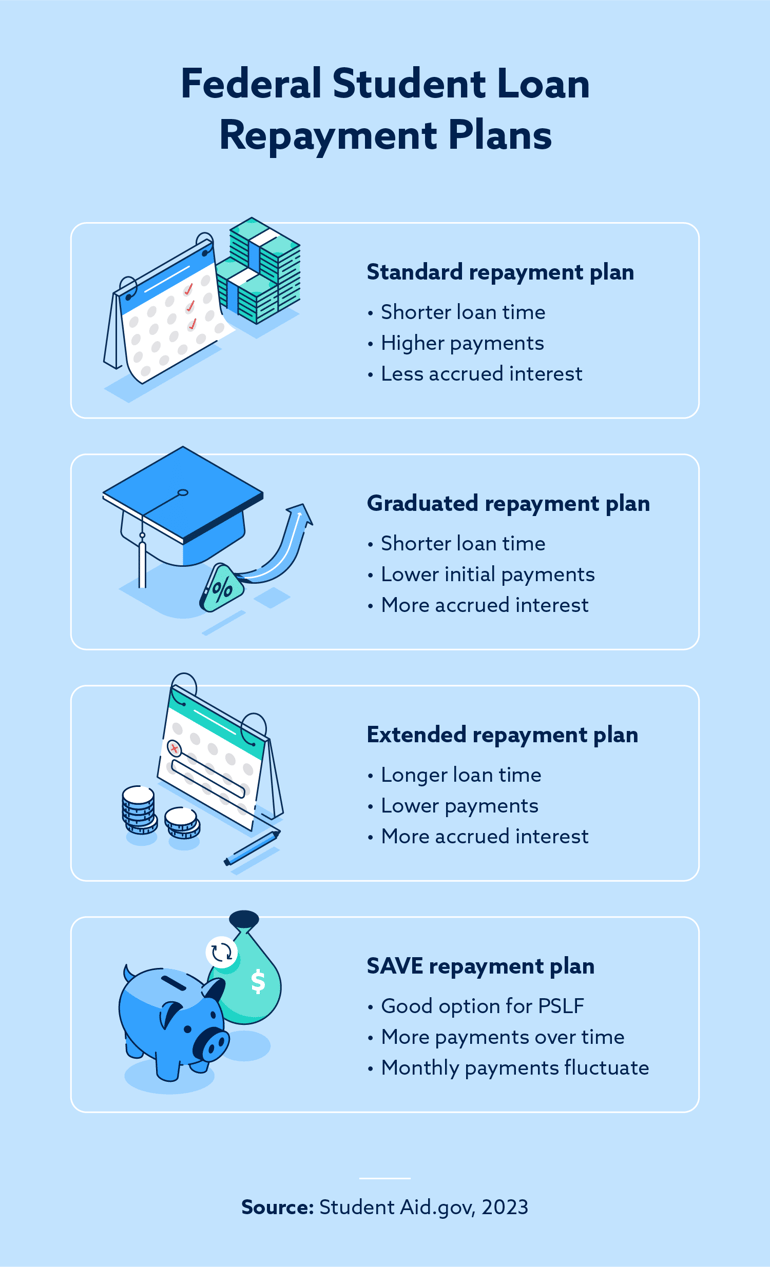
What to do next: Check out the Federal Student Aid’s loan simulator tool to help you understand which repayment plan is best for you.
If you have multiple student loans—federal or private—you may want to consider the debt snowball method. First, you aggressively tackle the smallest student loan, contributing as much as possible toward it while still making the minimum payments on the other loans.
Once your smallest student loan is paid off, shift your efforts to the next debt with the smallest balance. Contribute everything you were paying to the previous debt plus the minimum payment of the new one. This continues until all of your student debt is paid off.
While this method takes a bit longer, it helps you stay motivated by building momentum over time and allowing you to celebrate small victories. Rather than climbing one huge mountain of student debt, it lets you tackle each task one by one, making debt management easier and more approachable.
What to do next: Review your student loans and determine the order in which you will pay them off. Then, decide on the maximum amount you can contribute to get the snowball rolling.
When you consolidate your student loans, you are taking all of your student loans—federal, private, or both—and moving them to a different lender. This lender then pays off the loan for you, and you now owe this new lender the lump sum combined into one loan.
The goal of consolidating and refinancing is to get a lower interest rate and lower monthly payments. Ideally, you could keep your monthly payments the same or smaller, but the lower interest rate reduces the overall time of your debt repayment.
Make sure to do your research and see if you are actually getting a better interest rate—otherwise, you may end up in even worse debt than when you started.
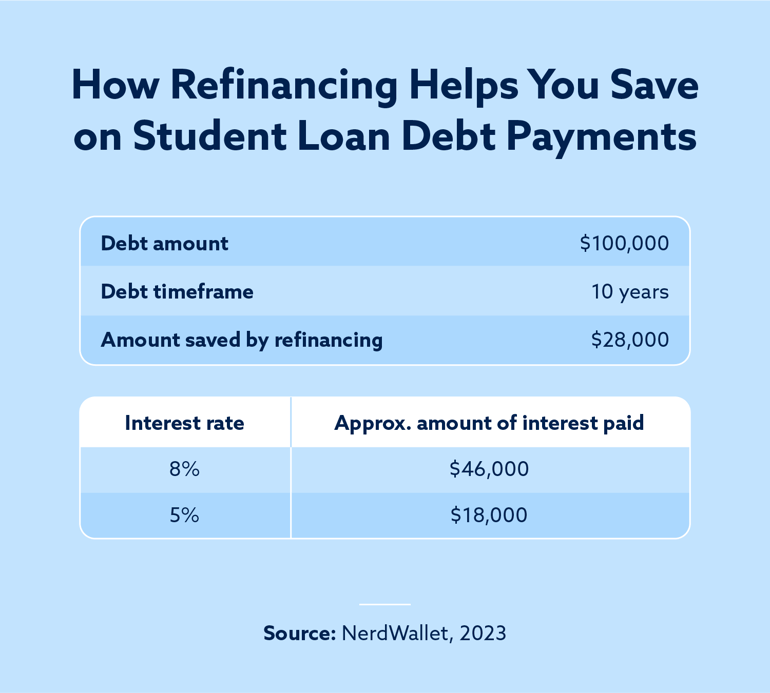
What to do next: Explore a loan payment calculator to see how much you would pay each month to determine if consolidating and refinancing is worth it.
Another great strategy for paying off debt is to use any extra money to make more payments. The most significant sources of extra funds most people encounter are raises and tax returns.
When you get a raise, it is tempting to increase your standard of living by signing up for a new subscription box or buying nicer clothing. However, this can easily make it feel like you never even got a raise in the first place—and this lifestyle creep can wind up causing you to blow your money on things you do not really need.
Instead, consider keeping your standard of living the same when you get a raise and put that extra income toward debt repayment. You will set yourself up for better financial health and enjoy a debt-free life sooner. This approach could be the fastest way to pay off student loans—if you plan wisely.
What to do next: If you recently received a raise, calculate the dollar amount your paycheck has increased by and add that to your student loan autopay.
Why not use nights and weekends to chase a hobby or passion project and monetize it to help pay off debt? This is a great option for those who have some spare time but do not want to sacrifice budget cuts. It’s also ideal for borrowers wondering how to pay off student loans faster. Simply use the income earned from your side hustle to make debt payments while keeping the rest of your expenses the same.
Even if you do not have very much free time, consider setting up a side hustle that will earn you passive income. While it may require a bit more work up front, the steady income stream you will enjoy over time will help lessen the burden of your student loan debt. Common ways of earning passive income include but are certainly not limited to:
What to do next: Research the best side jobs for paying off student debt, taking time to determine which one best fits your budget and schedule.
If you are still struggling to meet even minimum student loan payments, there are a few debt management and relief options to consider. Unfortunately, these come with some caveats, so consider them only as a last resort.
What to do next: Visit the Federal Student Aid’s Student Loan Forgiveness page or Income-Driven Repayment Plan page to check your eligibility and apply.
Student loan debt repayment is a journey that requires determination and discipline. Responsible debt management, especially early in life, is key to building credit and setting yourself up for financial health later in life.
If you are seeking credit repair services, the team at Lexington Law Firm can help you get back on the right path. Get your free assessment today.
Paying off student loans can be challenging, especially if you have high debt or a low income. However, you can tackle your student loans by creating a budget and a plan that works for you and staying disciplined throughout the repayment process.
There are also alternative options for borrowers who can’t afford to start or continue repayment, including forbearance plans and loan forgiveness.
You can use a combination of strategies to pay off all your student loans, such as:
Additionally, it may be helpful to seek the advice of a financial professional to guide you through the process.
The best way to pay off student loans depends on your financial reality and long-term goals, but two cost-effective repayment options are:
Keep in mind that it’s always important to research and find a plan that works for your individual situation.