
How many credit cards should I have?
October 13, 2025

The information provided on this website does not, and is not intended to, act as legal, financial or credit advice. See Lexington Law’s editorial disclosure for more information.
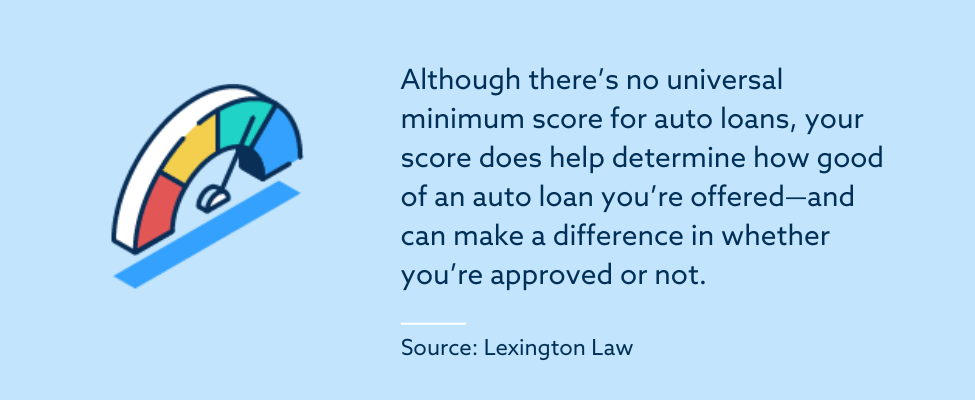
Although there's no real minimum credit score needed to buy a car, a higher score will make it easier to get approved, negotiate and earn better loans terms. Generally, a FICO® score above 600 can qualify you for an auto loan, but it depends on the lender, type of car and other factors. Good credit scores tend to earn more favorable loan terms, saving you money over the life of the loan.
If your score is below 600, don’t despair. It’s still possible to get a car loan, even if you have to go with a lender that works with high-risk borrowers. The terms may be less favorable, but you should still be able to purchase a vehicle.
There’s no minimum credit score that automatically qualifies you for a car loan because there are multiple types of credit scores, and banks can set their own lending requirements. However, a credit score above 600 can help you secure better auto loan terms.
Your score helps determine how good of an auto loan you’re offered — and improves your chances of getting approved. Lenders also consider factors like your income, employment status, monthly expenses and credit risk when determining whether you qualify for financing.
Every credit score falls into one of five tiers used to assess a borrower’s risk profile for lending purposes:
Higher "super-prime" scores indicate a potential borrower is at a lower risk than those with low "deep subprime" scores.
Someone with a better credit score usually has a lower credit risk, which can prompt lenders to offer better loan terms — this translates to better interest rates and more money saved over the life of an auto loan.
| Credit score | Average loan rate for a new car in 2025 | Average loan rate for a used car in 2025 |
| 750+ | 6.94% | 7.19% |
| 700 – 749 | 6.94% | 7.19% |
| 600 – 699 | 6.69% | 6.94% |
| 451 – 599 | 15.69% | 15.94% |
| 450 and below | N/A | N/A |
Source: U.S. News Cars as of March 2025
A better credit score can earn multiple benefits when shopping around for an auto loan:
Still not convinced it’s worth the effort to keep your credit healthy? Here’s an example of how much money you could save over the life of a 60-month auto loan for a new car with a score in the prime tier versus a score in the subprime tier.
| Credit score | Loan amount | Interest rate | Monthly payment | Total interest paid | Total cost of vehicle |
| 710 (prime) | $25,000 | 6.94% | $494.32 | $4,659.35 | $33,409.35 |
| 590 (subprime) | $25,000 | 15.69% | $603.84 | $11,230.48 | $39,980.48 |
In this scenario, the person with better credit pays $6,571.13 less over the life of the loan. The monthly payment is also $109.52 lower per month, leaving more money available for saving, investing or paying off debt.
Several companies have their own proprietary credit scoring models, but the five most important factors in determining your credit score are:
FICO has more than one scoring model, giving lenders several options when determining how to assess risk. One model produces scores designed specifically for auto lenders. Unlike traditional FICO Scores, FICO Auto Scores range from 250 to 900. These auto-specific scores are based on your regular FICO Scores, but they’re adjusted to help lenders predict the likelihood that you’ll pay back an auto loan as agreed.
It’s up to each lender whether they use a traditional FICO Score, FICO Auto Score, VantageScore or a score from some other scoring model. Many lenders use FICO Auto Scores because they put more weight on your auto loan payment history than the standard scores.
It can be worth checking your scores to find out where they all stand. If your FICO Auto Score is significantly higher than your standard score, you may be able to save money by looking for a lender that relies on FICO Auto Scores to make financing decisions.
Many car insurance companies use an Auto Insurance Score (AIS) to determine your insurance premiums and rates. Your AIS is meant to indicate the likelihood of you getting into a car accident and filing a claim. The higher the risk, the higher your insurance rate and premium.
Your AIS weighs several factors:
It surprises most people to know that the credit score is given the highest priority in the calculation. Insurers are looking to see how much financial liability the consumer has taken on in the past and how they’ve managed it.
So, a low credit score can cost you more when buying a car — and it can drive your insurance premium up, too. In fact, some car insurance companies may deny you coverage if your credit score is too low. Note that not all car insurers use AIS, but the majority do.
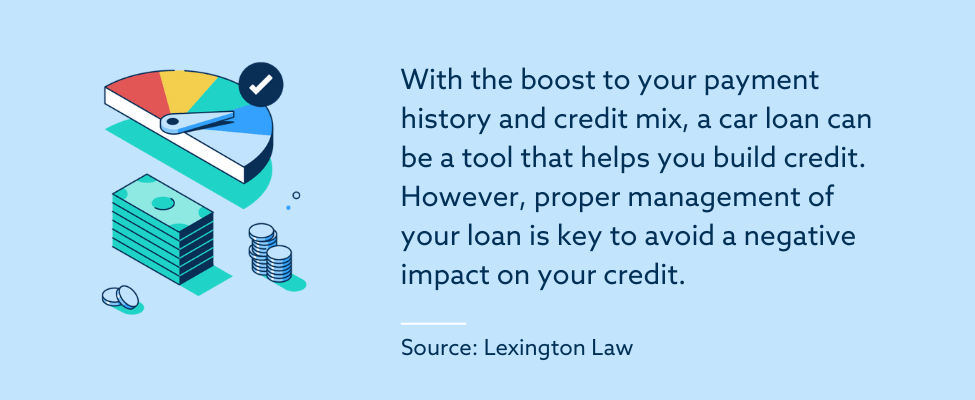
Having a car loan will primarily contribute to two factors that make up your credit score:
An auto loan can help or hurt your credit, depending on whether you build healthy financial habits. For example, your credit may take a hit if you miss or make late payments.
Having both revolving credit and installment loans shows a healthy credit mix and that you’re able to handle different types of financial responsibilities. Many people only have credit cards, which is revolving credit, so a car loan can improve your credit mix.
It’s still possible to qualify for a car loan if you have bad credit. You’ll just have to do a little extra work before you apply.
The first step is knowing what to expect when you apply for a loan. Check your credit report to ensure it represents you fairly and accurately. You can get your credit reports for free from AnnualCreditReport.com (note that this site only provides credit reports, not scores).
Then, check your scores to find out which score tier you fall into. Some free services provide a single informational credit score, but this may not be the same as your FICO Auto Score. To get all your credit scores, including your FICO Auto Scores, you may need to sign up for a paid service that provides comprehensive listings of your scores.
If your credit health is slightly too poor for you to qualify for an auto loan on your own, you may be able to get financing if you have a cosigner. This is someone willing to take responsibility for making sure the loan gets paid on time. Your cosigner should have a strong credit profile to give you the best chance of getting approved.
The bigger your down payment, the lower the principal amount of your auto loan. Even if a lender isn’t willing to give you a loan for $20,000, they may be willing to give you one for $10,000, so saving a larger down payment gives you a better chance of qualifying for financing.
If you don’t qualify for a loan from your bank, that doesn’t mean you won’t qualify elsewhere. Some lenders specialize in working with applicants who have less-than-stellar credit scores. Just be aware that these lenders typically charge higher interest rates to account for the higher risk of lending to people with subprime credit profiles. Local credit unions may also be willing to work with you.
If you don’t need a vehicle right away, it’s worth taking some time to improve your credit before you apply for an auto loan. Here are a few things you can do to work on your credit before you start shopping for a car:
Good credit can help you get the most favorable terms when it’s time to apply for an auto loan. But don't lose hope if your credit isn’t where you’d like it to be.
The legal advocates at Lexington Law Firm could help you address negative items on your reports as you work toward strengthening your overall credit profile. You can get started with your free credit assessment today and work to build the credit score you need to buy a car.