
How many credit cards should I have?
October 13, 2025

The information provided on this website does not, and is not intended to, act as legal, financial or credit advice. See Lexington Law’s editorial disclosure for more information.
Your credit score carries tremendous weight. The purpose of your credit score and your credit reports is to give lenders and others a quick, easy way to assess the level of risk they will be taking if they enter into a financial relationship with you. It’s used by lenders, landlords, insurance companies and others to determine your level of risk and responsibility.
The higher your credit score, the lower the risk to the lender, because your high credit score indicates you have been financially responsible. Your credit score impacts your ability to purchase a new home or a car or to rent an apartment. A good credit score can play into your ability to secure insurance and can save you lots of money.
Here we’ll cover credit scores, what makes them “good” or “bad” and what you can do to monitor yours.
Credit scores are calculated using an algorithm. Anytime you borrow money from a lender, information about that account was likely shared with at least one of the three major credit bureaus (Equifax, TransUnion and Experian). If you’re seeking credit from a bank or credit union, they will use the information from these credit bureaus to make a lending decision.
Manually combing through all the details of your credit and payment history would be a big task for any lender. That’s why lenders depend on credit scoring companies like FICO® to generate your credit score.
You might be surprised to learn that your credit score isn’t on your credit reports—your credit reports only contain the information that’s used to determine your credit score. So, if you want to check your score, you’ll need to either check with your credit card company, request your score through your bank or sign up for an online service. You can also request it from the bureaus themselves, but this usually costs money.
Keep in mind that your score might vary depending on which bureau’s report and which scoring method are used to determine the score. It’s still good to get an idea of what a lender might see when they check your credit.
There are multiple different credit scoring formulas currently in use, but most of them operate on a scale of 300 – 850. Each credit score has its own variations on the same basic concept. The most commonly used scoring method, maintained by the Fair Isaac Corporation, is the FICO® Score.
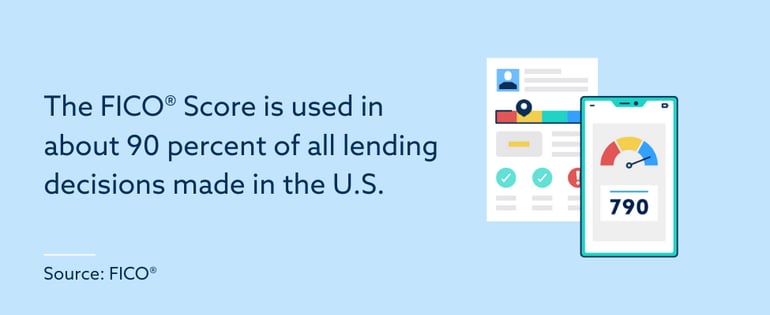
If a lender has ever pulled your credit report and gotten back to you with your current credit score, there is a very good chance it was a FICO Score they gave you, as the FICO Score is used in about 90 percent of all lending decisions made in the U.S. The following credit score ranges are generally accepted ranges used by many lenders:
Of course, regardless of the label anyone chooses to put on a score, the bottom line is the higher your credit score, the more likely you are to be extended credit.
If you pay your bills on time every time, keep revolving balances low and only open new credit when necessary, you're likely to have a good FICO Score.
However, we can dive a little deeper into the subject. The following five factors are key to achieving and maintaining a good credit score, no matter which scoring system is being used. The percentages listed refer to how heavily these factors weigh into your FICO Score:
Lenders want to see that you consistently pay your bills on time, and that you pay at least the minimum required amount each time they’re due. Even one late payment or missed payment can have a serious impact on your credit score, so prioritize making payments on time and for the full amount.
This is how much of the total amount of credit available to you is being used. For instance, if you have $10,000 of total credit available and your month-to-month balance is $3,000, you have a ratio of 30%. A good guideline is to keep your credit utilization as low as possible.
A longer credit history scores better than a shorter one. To help your score, don't close old accounts, even if they have a $0 balance. As an account stays on your record, it adds to your total available credit and the total length of your credit history.
A hard inquiry may occur when a lender pulls your credit report in response to your request for credit, such as when you apply for a credit card or a car loan. A large number of inquiries in a fairly short time can hurt your score, so make sure to do your due diligence and only fill out an application when it's truly needed.
This factor displays a well-rounded credit history. A good mix of credit will consist of revolving debt (credit cards) and installment debt (car loans, student loans, etc.).
There are several ways to hurt your credit score. As you may have guessed from the previous list, not paying your bills on time is one of the most common ways credit scores suffer. Some other common mistakes people make that result in a bad credit score include:
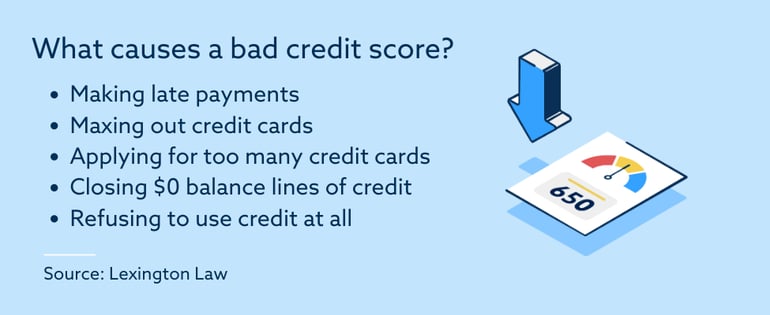
It’s important to remember that inaction can have just as much impact as positive or negative action, so it’s important to be proactive if you want to improve your credit score.
Bad credit certainly won’t do anything in your favor to impress potential lenders, landlords or employers. The bottom line is they are likely to view your unstable financial past as an indication of your future financial behavior. Because of the perceived business risk, lenders may not want to lend to you.
If they do, they’ll likely charge you higher interest rates. Employers may decide to pass you over in favor of someone with better credit. Additionally, insurance companies may charge higher premiums to compensate for your perceived level of risk.
Your credit scores should only be based on certain financial facts and shouldn't be biased against you. Some of the things that don’t impact your credit score are your:
Additionally, if you have received public assistance in the past, this is not factored into your score. U.S. law protects individuals from discrimination by prohibiting these items from being factored into your credit score.
It’s also important to note that if you’re applying for something big like a car loan or a mortgage, the lender may ask you for your salary and employment status to make sure you can pay the loan back, but this has no bearing on your credit score.
There are many ways to improve your credit. Keeping old credit cards open is one way; another is to spread out credit card debt across multiple cards. You can learn more about how to improve your credit and build credit.
Not every individual with bad credit is a high risk. Cases of identity theft, inaccurate information and other examples of unfair credit reporting may depict a consumer in an unjustifiably wrong light.
It’s up to you to determine whether your credit score accurately reflects your financial past. That’s why you should take advantage of your rights under the Fair Credit Reporting Act (FCRA), including your right to a free credit report from each of the three major credit bureaus every year, and the right to dispute any unfair, inaccurate or unsubstantiated items you find on those reports.
If you’re not sure how to dispute information on your credit reports, or if you feel overwhelmed, you can seek help from professionals who can guide you through the process and act as advocates for you.
For over a decade, Lexington Law has helped clients work toward fair and accurate credit reports by leveraging their rights. Credit reporting is a complex process, but asking the right questions about your credit reports doesn't have to be.