
How many credit cards should I have?
October 13, 2025

Key takeaways:
A credit freeze can be a powerful tool to help keep your finances safe if you’ve been a victim of identity theft or are worried you might be. Learning how to freeze your credit report can prevent damage to your credit should your personal information be stolen. However, if you need to allow quick access for a credit check, a freeze will slow the process down.
If you’re not sure whether a credit freeze is right for you, this guide can give you the information you need to help you decide.
Table of contents:
A credit freeze is a free security measure that restricts access to your credit file. While a freeze is in place, potential lenders cannot perform a credit check to approve your application. As a result, no new credit accounts can be opened in your name until you lift the freeze.
A limited number of people, like yourself and your preexisting creditors, can still access your credit report, though. This means that if you wanted to ask to increase the limit on your current credit card, the company could still look at your credit report to make that decision.
Those who aren’t authorized won’t be able to retrieve your credit report. Freezing credit can help shield against identity theft because scammers typically try to open new lines of credit in your name.
A credit freeze and a credit lock can both restrict access to your credit report, but they have some differences. A credit lock is an upgraded service the major credit bureaus—Experian®, Equifax® and TransUnion®—provide, but it can cost money. Some prefer a credit lock because it can be more convenient, allowing you to lock and unlock your credit through an app.
When learning how to lock your credit, remember that it comes with fewer legal protections than a credit freeze.
You’ll have to submit a credit freeze request to the major credit bureaus to restrict access to your credit report. You can call or fill out a form with each of the bureaus.
It can also be beneficial to freeze your credit with the smaller bureaus:
When you contact Experian, Equifax, TransUnion or the other bureaus, you’ll need to provide personal information to prove your identity. The information each bureau requests may differ, but here are some of the most commonly requested items:
You may also need other information like a tax return or bank statements for additional verification.
If you think your child may be at risk of identity theft, you may want to freeze your child’s credit. Identity theft can damage your child’s credit at a young age. For children under 16, here are the steps you can take:
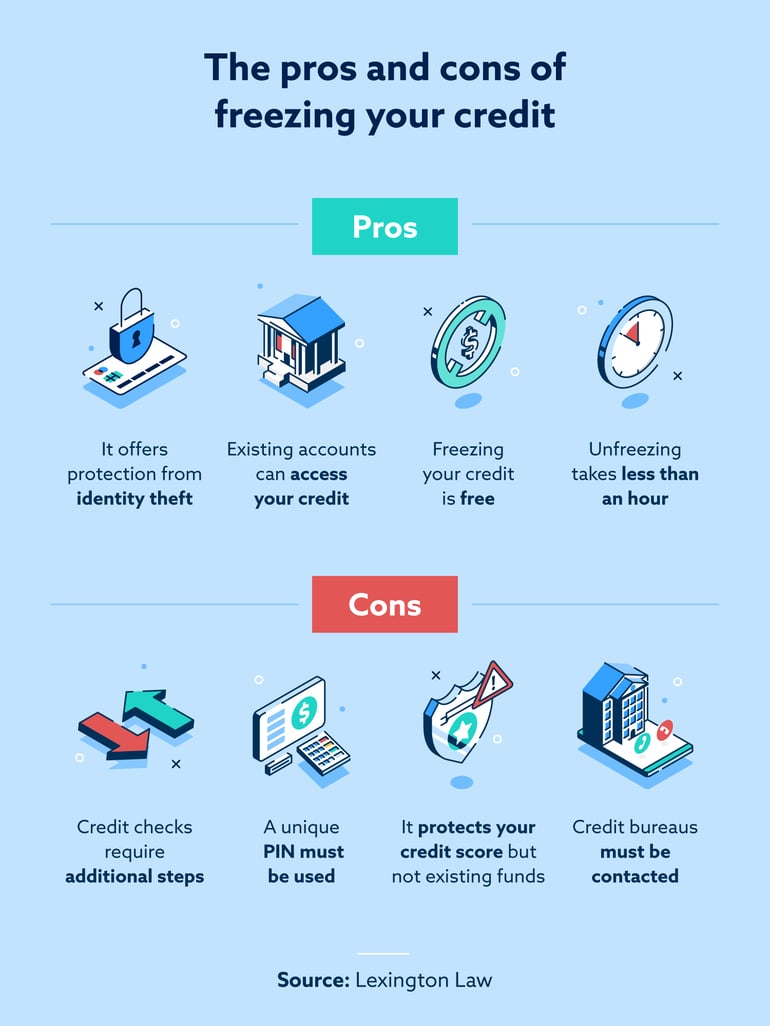
A credit freeze might seem like an obvious response to identity theft, but there are downsides. If you need to do something that requires a credit check, like applying for a loan or opening a new cellular service account, you’ll need to unfreeze your account first.
You can freeze and unfreeze your account as much as you’d like, but it requires contacting each bureau. If you know an entity will need access to your credit soon, you may want to hold off.
Here are some situations when freezing your credit may be a good idea:
You do not need to apply for any loans or other items that may require a credit check.
A credit freeze can be an effective tool in helping keep your identity safe, but there are some downsides.
If you decide to freeze your credit report, some people or companies may still be able to access your credit. These exceptions include:
You’ll also be able to access your credit report while it’s frozen, but you may need to provide the unique PIN you were given by Experian, Equifax or TransUnion.
To unfreeze your credit, you’ll need to reach out to the bureaus, ask them to lift the freeze and provide your PIN. You can also unfreeze your credit online by navigating to the same website used to set up the credit freeze.
The lift will happen within an hour by phone or online or within three days by mail. You can unfreeze temporarily or indefinitely.
Below, we’ve answered some common questions regarding freezing your credit.
Unfortunately, there is no way to freeze all three credit reports at the same time. You need to submit a separate freeze request to each credit bureau.
No, freezing your credit doesn’t impact your credit score.
Both freezing and unfreezing your credit is free. Credit locking services, on the other hand, may cost a fee.
Fraud and identity theft can harm your credit if the identity thief opens credit accounts in your name. A good preventive measure is to set up a fraud alert, but sometimes it’s too late. If identity theft or fraud has harmed your credit, Lexington Law Firm may be able to help.
Our consultants have experience helping clients address credit report errors that can negatively affect their credit. As part of our services, we also provide our clients with credit monitoring and alerts through our app as well as identity theft insurance. To learn more, check out our Identity Theft Focus Track today.